HELOC vs. Cash-Out Refinance: Which Is Better Right Now?
By Mortgage Wizard, NJ Licensed Real Estate Salesperson · Updated November 24, 2026
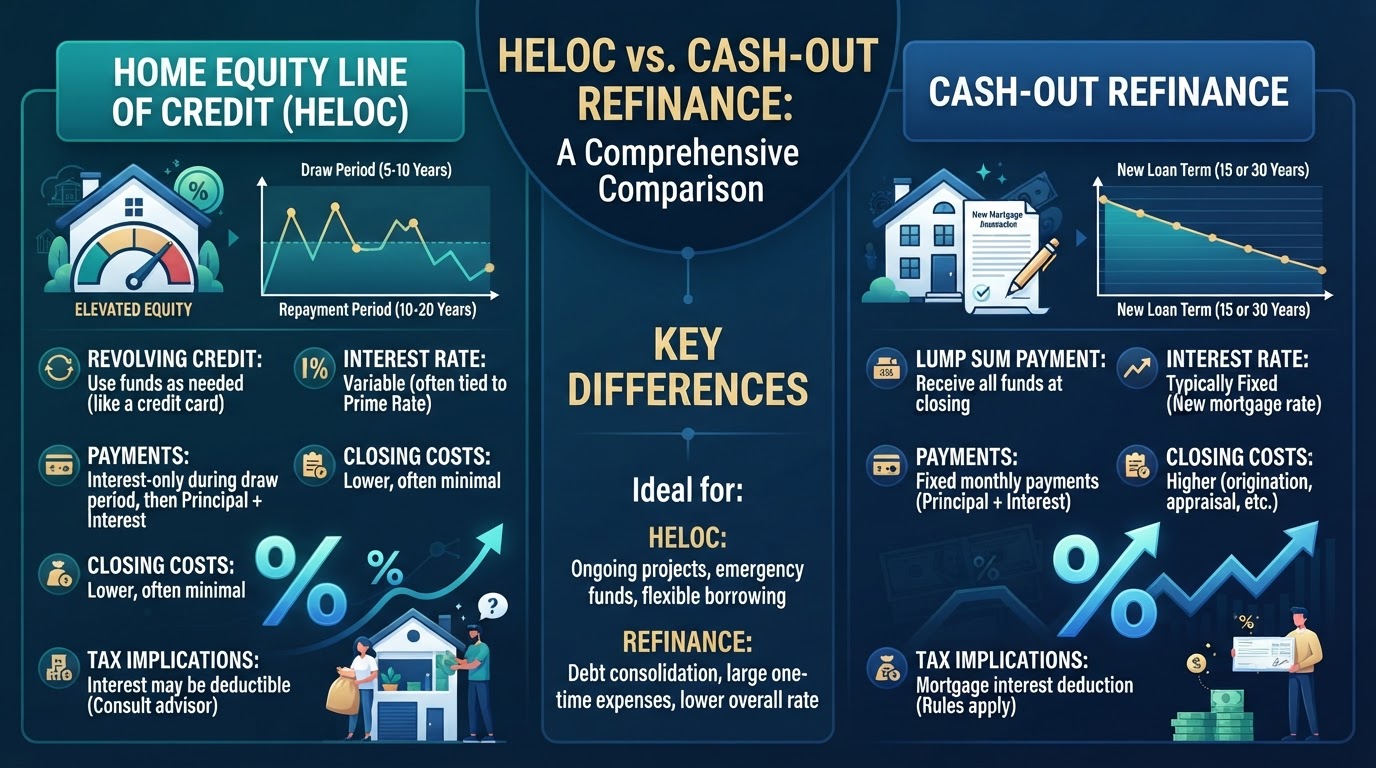
If your current mortgage rate is well below today's rates, a HELOC or home equity loan usually costs less overall. It lets you borrow against your equity without replacing your low-rate first mortgage. A cash-out refinance replaces your whole loan at the new rate, which mostly makes sense if your current rate is already near today's.
How a HELOC Works
A HELOC, or home equity line of credit, works like a credit card secured by your home. You get approved for a maximum credit limit based on your equity, and you can draw from it, pay it back, and draw again during the draw period — usually several years. You only pay interest on the amount you actually borrow, not the full limit.
Most HELOCs are variable and tied to the prime rate, which moves with the federal funds rate. That means your rate can rise or fall over time, and your payment changes with it. After the draw period ends, you enter a repayment period where you can no longer borrow and pay down the balance over a set term.
The appeal is flexibility. You can tap your equity for renovations, debt consolidation, or other big expenses, and you only pay for what you use. The trade-off is uncertainty — because the rate is variable, your payment can climb if rates rise, which is the main risk to understand before you commit.
How a Cash-Out Refinance Works
A cash-out refinance replaces your entire first mortgage with a new, larger loan. You pay off your old loan, keep the difference in cash, and start over with a single mortgage at the new rate and term. It's one loan, one payment, and a fresh amortization schedule.
Because a cash-out refinance replaces the entire first mortgage at the new rate, the math depends heavily on where your current rate sits. If you're refinancing out of a 3.5% mortgage into a 7%+ loan to pull out cash, the higher rate applies to your whole balance — not just the extra you're borrowing. That can wipe out the benefit of the cash you take out.
On the other hand, if your current rate is already close to today's market rate, replacing the loan doesn't cost you much in rate, and the cash you pull out is effectively borrowed at a similar rate. In that case, a cash-out refinance can be the simpler path. To see what a new payment would look like, run your numbers through our refinance calculator.
Want to See Your Real Numbers?
Compare your options side by side and see real numbers for your budget in about 60 seconds.
Compare Your Options →Home Equity Loan: The Fixed-Rate Middle Option
A home equity loan is the third option, and it sits between the two. Like a HELOC, it's a second loan on top of your first mortgage — your original loan stays in place. Like a cash-out refinance, it gives you a lump sum up front with a fixed rate and a fixed monthly payment for the full term.
That makes it a good fit when you know exactly how much you need and you want the certainty of a payment that never changes. You don't get the flexibility to borrow and repay like a HELOC, but you also don't carry the variable-rate risk. For homeowners who want to preserve a low first-mortgage rate and still need a set amount of cash, a home equity loan often splits the difference cleanly.
The choice between a HELOC and a home equity loan often comes down to how you'll use the money. If you need funds over time or aren't sure of the total, a HELOC's flexibility wins. If you have a one-time expense and want a predictable payment, the home equity loan is usually the better fit.
Why Your Current Rate Decides It
The single biggest factor in this decision is the rate on your existing mortgage. Nearly half of current mortgages carry rates of 4% or lower. If you're in that group, replacing that loan with a cash-out refinance at today's rates means paying a much higher rate on your entire balance — not just the cash you're pulling out.
Freddie Mac's 30-year fixed average was 7.28% for the week of Nov 19, 2026. Moving from a 3.5% loan to a 7%+ loan to access, say, $50,000 in equity could cost you far more in extra interest on your main balance than you'd ever save from the cash. In that situation, leaving the first mortgage alone and borrowing against your equity separately is usually the cheaper path.
If your current rate is already near today's market rate, the calculus flips. Refinancing doesn't raise your rate much, and rolling your cash needs into one new loan is simpler than managing a second lien. Use our mortgage calculator to compare what a new payment would look like at today's rates.
How the Fed Hike Affects HELOC Rates
Because most HELOCs are tied to the prime rate, Federal Reserve decisions hit them directly. The Fed raised rates 0.25 points on Sept 16, 2026, and prime rose by the same amount. For HELOC borrowers, that meant a rate increase that showed up within a billing cycle or two.
This is the core trade-off of a variable-rate product. When the Fed cuts rates, your HELOC payment drops along with them. When the Fed raises rates, your payment climbs. If you expect rates to fall over time, a HELOC can get cheaper. If rates keep climbing, it gets more expensive — and there's no cap on how high the variable rate can go, unlike a fixed-rate loan.
If you're worried about future increases, a home equity loan's fixed rate removes that risk entirely. Some HELOCs also let you convert part of your balance to a fixed rate during the draw period, which can be a middle ground worth asking your lender about.
How Much Equity You Can Borrow
Across all three options, lenders generally want you to keep a cushion of equity in the home. A common guideline is that your combined loan-to-value ratio — your first mortgage plus any second lien, divided by the home's value — stays at or below 80% to 85%, though some programs allow more.
That means if your home is worth $500,000 and you owe $300,000 on your first mortgage, you may be able to borrow a portion of the remaining $200,000 in equity — but not all of it. The exact limit depends on the lender, the product, your credit, and your income. The more equity you have above the lender's threshold, the more you can tap.
Keep in mind that borrowing against your home puts it on the line. If you can't make the payments on a HELOC, home equity loan, or refinanced mortgage, you risk foreclosure. Equity is a resource, but it's also your safety net — tapping it should be a deliberate decision, not a casual one.
Costs and Risks to Compare
Each option carries different up-front costs. A cash-out refinance typically comes with full closing costs similar to your original mortgage — appraisal, title, origination fees — which can run into the thousands. A HELOC or home equity loan usually has lower closing costs, and some lenders waive them entirely if you keep the line open for a set period.
The risks differ too. A HELOC's variable rate can rise and push your payment higher, and the repayment period after the draw can bring a payment jump. A cash-out refinance locks in a fixed payment but restarts your amortization, meaning you pay more interest over a longer timeline if you reset to a new 30-year term. A home equity loan adds a second monthly payment on top of your first.
The right choice comes down to your current rate, how much cash you need, how you'll use it, and your comfort with payment uncertainty. There's no universal winner — only the option that fits your situation. If you're unsure, comparing real numbers side by side is the fastest way to decide.
Ready to Compare Your Options?
See real numbers for your situation in about 60 seconds — no credit pull, no signup.
Compare Your Options →Frequently Asked Questions
HELOC or cash-out refinance: which is better right now?
If your current mortgage rate is well below today's rates, a HELOC or home equity loan usually costs less overall. It lets you borrow against your equity without replacing your low-rate first mortgage. A cash-out refinance replaces your whole loan at the new rate, which mostly makes sense if your current rate is already near today's.
Did the Fed's rate hike raise my HELOC rate?
Probably. Most HELOCs are variable and tied to the prime rate, which moves with the federal funds rate. After the Fed's quarter-point hike in September 2026, prime rose by the same amount, so many HELOC rates went up within a billing cycle or two.
MyMortgageWizard is an educational resource and independent marketing portal. We are not a lender or broker and do not issue loan approvals or lock rates. Rates and program rules change; confirm details with a licensed lender.