ARM vs. Fixed-Rate Mortgage: Which Is Better Right Now?
By Mortgage Wizard, NJ Licensed Real Estate Salesperson · Updated November 24, 2026
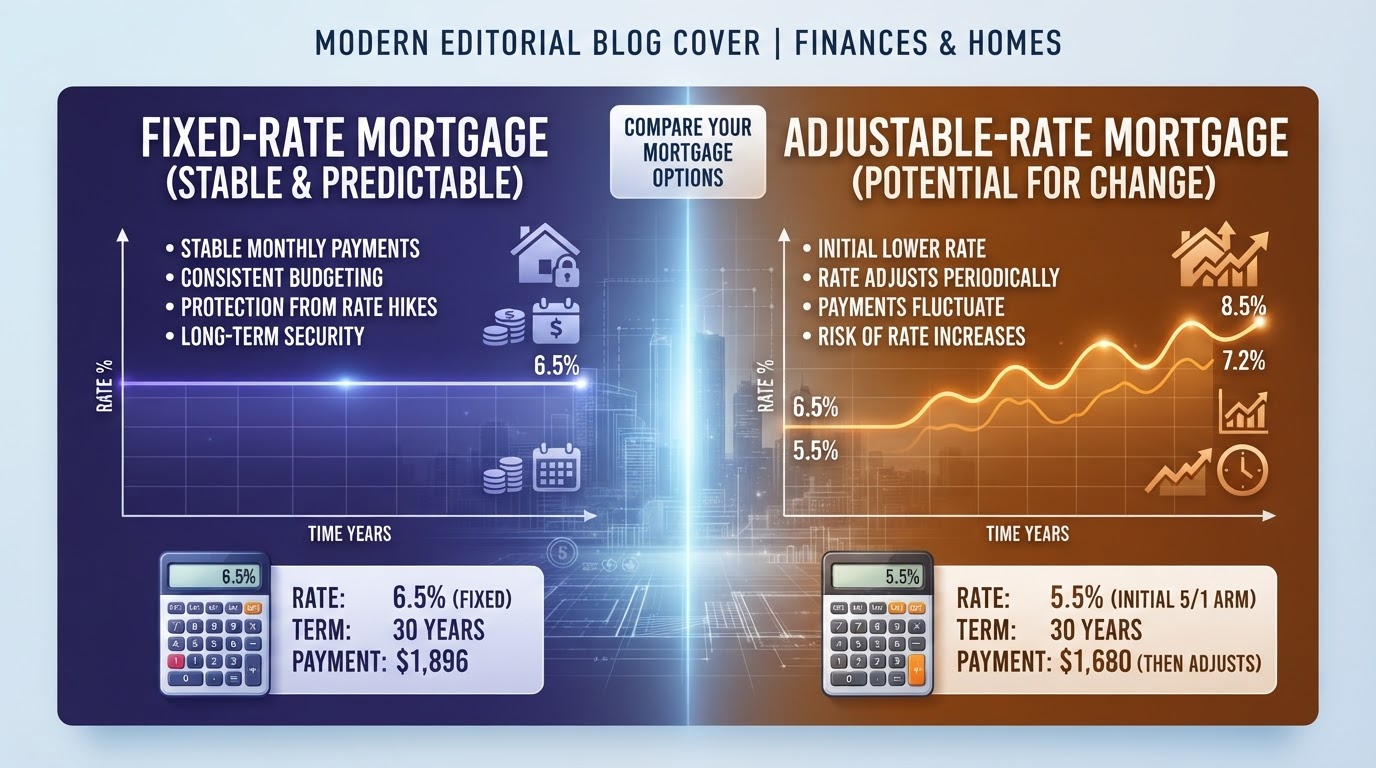
An ARM can make sense if you plan to sell or refinance before the fixed period ends. In October 2026, the 5/1 ARM averaged about 6.4%, vs about 7.4% for a 30-year fixed. The risk is that your rate and payment can rise after the intro period, so make sure you could afford the payment at the loan's maximum rate.
How a Fixed-Rate Mortgage Works
A fixed-rate mortgage is the simplest loan to understand. Your interest rate is set when you close on the loan, and it never changes for the entire term. If you lock in 7.4% on a 30-year loan, you pay 7.4% for all 30 years — whether rates rise or fall after that.
Because the rate never moves, your principal-and-interest payment never moves either. The only things that can change are the parts of your payment that go into escrow, like property taxes and homeowners insurance. For most buyers, that predictability is the whole point: you know what your payment will be in year one and year 30 alike.
The trade-off is that fixed rates are usually higher than the starting rate on an ARM. In a high-rate environment, that premium can feel steep, but it buys you certainty. To see what a fixed payment looks like at today's rate, plug your numbers into a mortgage calculator.
How an ARM Works
An adjustable-rate mortgage, or ARM, starts with a fixed-rate period, then switches to an adjustable rate for the rest of the term. During the fixed period — often 5, 7, or 10 years — your rate and payment stay put, just like a fixed loan. After that, the rate resets on a set schedule.
The appeal is the starting rate. Because the lender isn't locking in a rate for 30 years, the initial rate is usually lower than what a 30-year fixed costs. That lower rate means a lower monthly payment during the intro period, which is what draws buyers in.
The catch is what happens after the fixed period ends. Your rate resets based on a market index plus a set margin, and it can go up or down. Most of the risk people worry about is on the upside — if rates climb, so does your payment. Rate caps help limit that risk, but they don't remove it.
Want to See Your Real Numbers?
Compare your options side by side and see real numbers for your budget in about 60 seconds.
Compare Your Options →What 5/1 and 5/6 Mean
ARM names tell you two things: how long the rate stays fixed, and how often it adjusts after that. The first number is the length of the fixed period in years. The second number is how often the rate resets once the fixed period is over.
A 5/1 ARM is fixed for the first 5 years, then adjusts once every year after that. A 5/6 ARM is also fixed for 5 years, but then adjusts every 6 months. The same pattern applies to other common loans: a 7/1 ARM is fixed for 7 years then adjusts yearly, and a 10/1 is fixed for 10 years then adjusts yearly.
The longer the fixed period, the more time you have before any adjustment risk kicks in — but the starting rate is usually a little higher, since the lender is locking in that rate for longer. The shorter the fixed period, the lower the starting rate tends to be, but you reach the adjustment window sooner.
Rate Caps: How High Can Your Payment Go?
Rate caps are the guardrails on an ARM, and understanding them is the most important part of choosing one. There are three caps to know about, and they're all listed on your Loan Estimate.
The initial cap limits how much your rate can rise at the first adjustment after the fixed period ends. The periodic cap limits each adjustment after that. And the lifetime cap sets the maximum your rate can reach over the life of the loan — the ceiling it can never cross, no matter what markets do.
Here's why that matters: if your starting rate is 6.4% and your lifetime cap is 5 percentage points, the highest your rate can ever go is about 11.4%. Before you take an ARM, figure out what your payment would be at that maximum rate. If you could still afford it, the risk is manageable. If not, a fixed rate may be the safer call. You can run both scenarios with our refinance calculator to see how a future change would affect you.
Today's ARM vs. Fixed Rate Gap
In October 2026, the 5/1 ARM averaged about 6.4% versus about 7.4% for the 30-year fixed, according to MBA contract rates. That's a full percentage point gap at the start of the loan. On a $400,000 balance, a 1% rate difference is roughly $260 a month — real money that adds up fast over the fixed period.
That gap is why ARMs are getting more attention. In October 2026, ARMs were 10.8% of mortgage applications, according to MBA data reported by NAHB. When the fixed-to-ARM spread widens, more buyers weigh the lower starting payment against the adjustment risk.
But the gap isn't a free lunch. You're trading certainty for savings, and the savings only last as long as the fixed period. If rates stay high or rise further when your ARM is ready to adjust, you could end up paying more over the long run than you would have with a fixed rate from the start.
Who an ARM Fits
An ARM tends to fit a specific kind of borrower: someone who doesn't plan to keep the loan for 30 years. If you expect to sell the home or refinance before the fixed period ends, you may capture the lower starting rate and never face an adjustment at all.
That includes buyers who move every few years for work, people who plan to trade up once their income grows, and anyone who expects to pay down the loan early. It can also fit borrowers who are comfortable with some payment uncertainty and have the income to absorb a future increase.
The key is a realistic exit plan. If you're confident you'll be out of the loan before the adjustment window opens, the ARM's lower starting rate can save you money without ever exposing you to the risk. If you're still deciding whether to buy at all, read Should You Buy Now or Wait for Rates to Drop?
Who Should Stick With Fixed
A fixed-rate mortgage is the better fit if you value certainty above all. If you're buying your long-term home, plan to stay for many years, and want a payment you can count on regardless of what the market does, the fixed rate's higher starting cost buys you that peace of mind.
It's also the safer call if your budget is tight. If a future rate adjustment would push your payment to a level you couldn't comfortably handle, the protection of a locked rate is worth the premium you pay for it. A fixed rate removes the risk of payment shock entirely.
Finally, if you're not sure how long you'll stay, a fixed rate keeps your options open without the clock ticking toward an adjustment. You can always sell or refinance later, but you're never forced to by a rate reset you didn't plan for.
Ready to Compare Your Options?
See real numbers for your situation in about 60 seconds — no credit pull, no signup.
Compare Your Options →Frequently Asked Questions
Is an adjustable-rate mortgage a good idea right now?
An ARM can make sense if you plan to sell or refinance before the fixed period ends. In October 2026, the 5/1 ARM averaged about 6.4%, vs about 7.4% for a 30-year fixed. The risk is that your rate and payment can rise after the intro period, so make sure you could afford the payment at the loan's maximum rate.
What happens when my ARM adjusts?
After the fixed period, your rate resets to an index plus a set margin, usually once every 6 or 12 months. Rate caps limit how much it can rise at the first adjustment, at each later adjustment, and over the life of the loan. Your loan estimate lists these caps.
What does 5/1 or 5/6 ARM mean?
The first number is how many years the rate stays fixed. The second is how often it adjusts after that: 1 means once a year, and 6 means every six months.
MyMortgageWizard is an educational resource and independent marketing portal. We are not a lender or broker and do not issue loan approvals or lock rates. Rates and program rules change; confirm details with a licensed lender.